
The data exists. The route to it does not.
Someone holds the records. Getting them released for your specific purpose is a different problem, and it is the one that decides your timeline.
Life sciences teams do not lack data. They lack a defensible path from the data to a decision. Aurumetrics builds that path: we find the data, secure the permissions, run the analysis in-market and hand back evidence you can put in front of a regulator, a payer or a board. Across nine Asia-Pacific health systems, and further where a partner exists.
AURUMETRICS
Aurum, gold · Metrics, the measure
Aurum is the Latin for gold, and the root of the word for the standard everything else is judged against. Metrics is the discipline of measuring things properly. The company was named for what it is meant to produce: gold-standard measures of what is actually happening to patients, in markets where that is genuinely hard to establish.
It is a high bar to name yourself after, which is the point. A number is only worth having if it survives the person who has to defend it.
Health data becomes useful only after custodianship, ethics, privacy, residency and linkage are resolved. Most programmes stall long before anybody opens a dataset.
Someone holds the records. Getting them released for your specific purpose is a different problem, and it is the one that decides your timeline.
Every Asia-Pacific health system has its own regulator, HTA body, payment model, coding conventions and governance law. Knowing one tells you very little about the next.
A broker, an analytics vendor, an ethics consultant and a translator, with you project-managing the seams and absorbing every delay that falls between them.
A study the data was never going to support costs far more than a feasibility read that says no. Most people find out in month four.
Aurumetrics reduces friction by structuring governance-aware evidence pathways before analysis begins. That is the whole method, and it is why our answers arrive on a schedule rather than an apology.
Three things that get talked about as if they were one. The gap between them is where most value is lost, and closing it is what we are for.
Most firms in this field sell one or the other. Running both is what keeps the services honest: we use our own product, so we know what a good one costs to maintain.
We source the data, secure the permissions, run the analysis in-market and build the evidence. One accountable party on one contract, so nothing waits in a queue between two suppliers who do not report to each other.
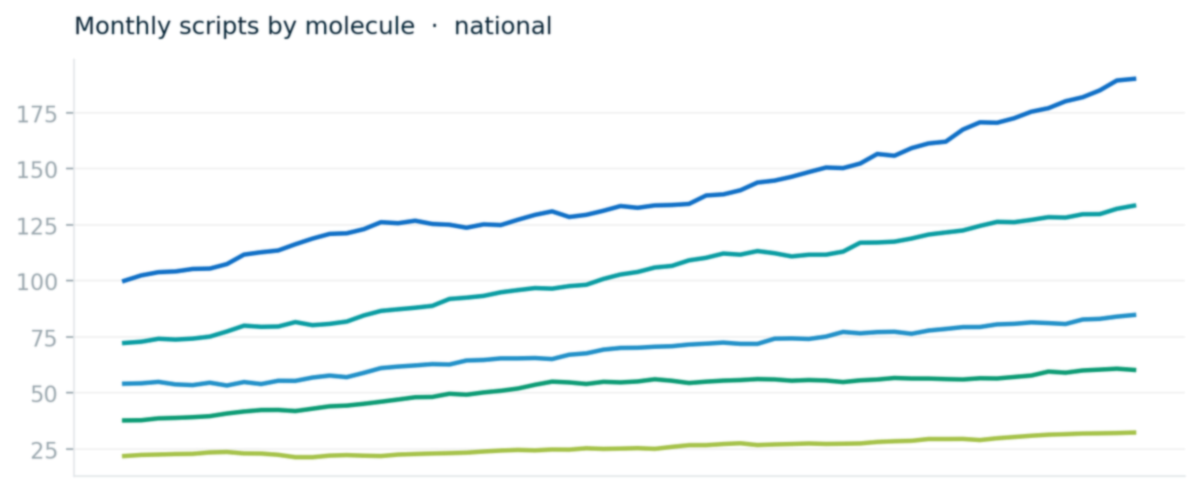
An analytics platform for the Australian market: pharmaceutical claims, medical services claims, hospital activity and hospital diagnoses in one place, refreshed monthly. Every therapeutic area and every company, at once.
"Access" means five quite different things in this field. Knowing which one your question actually requires is usually the single biggest saving available to you.
We will tell you the lowest level that answers your question, even when a higher one would be a larger piece of work for us. A cheaper answer that holds is worth more to both of us than an expensive one you cannot defend.
Counts and totals already in the public domain. No permission needed, no patient records involved.
A tabulation prepared to your specification by the party that holds the data, then released.
Record-level analysis performed inside the alliance partner's controlled-access environment. The data does not move.
A purpose-built extract released to you under a permission agreed for that use, with its specification and link-quality metadata.
The deepest level, and the most heavily conditioned. Discussed directly rather than advertised.
A governance-first, privacy-preserving architecture. Four entities, defined roles, and a controlled flow between them. Your legal team's usual worry is what happens to patient records once they leave the hospital. In this model, they do not leave.
Raw identifiable patient data never leaves the custodian's controlled environment. What moves to the alliance partner is a de-identified patient-level subset, accessible only inside a controlled-access environment, by credentialed analysts, with no raw extraction permitted.
For your legal team, this removes the longest item on the critical path. The cross-border data transfer agreement is normally the single slowest thing in a regional evidence programme. In this model there is not one to negotiate.
Our proven depth is in nine Asia-Pacific markets, which is where the alliance partners, the governance knowledge and the track record are. Where a question sits outside the region and a data partner exists, we will say so plainly and tell you what we can and cannot do there.
Most people who need this work are not data specialists, and should not have to be. Here is what each type actually is and what it is good for.
Records of what a public scheme paid for. Excellent for treatment pathways, volumes and cost. Blind to anything the scheme does not fund.
The same shape of record from private insurers. Strong where private coverage is dominant; the covered population is not the whole population.
What clinicians wrote down: diagnoses, notes, orders, results. The richest clinical detail available, and the messiest.
Admissions, procedures, length of stay, day cases. Answers where this is happening, and how much of it.
What was actually handed to a patient at a pharmacy, which is closer to real use than what was prescribed.
Test values over time. The difference between "was treated" and "responded", and essential for biomarker-defined cohorts.
Purpose-built collections for one disease or procedure. Deep, curated, consistent, and limited to what the registry was built to capture.
Biological samples with linked clinical records. The bridge between what is in a person's biology and what happened to them.
Sequencing and molecular profiling linked to outcomes. Where targeted-therapy questions are actually answerable.
Two or more sources joined at the patient level so a journey can be followed across settings. The most valuable and the most governed.
Census and vital statistics. Not clinical, but the denominator. Without it a count is a number, not a rate.
Existing cohort and surveillance studies. Often the fastest route to a defensible incidence or prevalence figure.
Availability differs by market. A data type that answers your question in one country may not exist, or may not be releasable, in the next. Read the full deep dive on all twelve or see what is available where.
Five steps, and the second one is the one that saves you money. A written feasibility view arrives before any money moves, and it sometimes says no.
A conversation, under NDA if you prefer. What decision are you trying to make, and by when.
Is it answerable, in which market, from which data type, how fast. In writing, before money.
Method note and cohort specification agreed and dated. This is where most projects are saved or lost.
Run in parallel with analysis design wherever governance permits.
You see the direction before you see the deck.
Alongside every engagement, from step three: weekly updates, monthly stakeholder reviews, methodology agreed before work starts, quality control at every phase, interim reports rather than a single reveal, and milestones you accept rather than discover.
Four to six weeks to a first feasibility read on hospital records where access is already established. Four things decide whether you get that: whether access exists, what approvals are needed, how precisely the question is specified, and how many markets are involved. The detail is here.
Real-world data punishes generalists. The difference between a defensible result and a misleading one is usually something nobody wrote down: a coding change three years ago, a scheme rule that makes an obvious denominator wrong, a field that means one thing in one province and something else in the next.
Aurumetrics runs as a network of the people who know those things. Senior researchers, many holding doctorates and post-doctoral research backgrounds, with two decades or more working directly with their own country's health system and its datasets, plus the analytics teams of our alliance partners in each market.
Large vendors put a senior name on the proposal and a junior team on the work, because a pyramid has to be fed. There is no pyramid here to feed, so the person who knows the market is the person on your project.
How the health system actually pays, codes and records, and what that does to a denominator.
Which datasets exist, who holds them, what they will and will not release, and how long each step takes.
What a clinically meaningful cohort looks like in this indication, and which endpoints a payer will accept.
Study design, causal inference, linkage quality, and the discipline to say when a result will not hold.
We will tell you whether the data can answer it, in which market, and how long it will take, before you commit anything.